
Inspectability release line
PaveDB in one page
PaveDB is the inspectable retrieval database: small enough to embed, complete enough to operate. You hand it files, it chunks, embeds and indexes them, and it answers semantic queries with the exact snippet that matched and where it came from. By default, text searches keep their query record and replay trail as well as their source provenance.
Use the same engine embedded in Python, self-host it over HTTP, or point the same clients at managed PaveDB. One interface carries the prototype into production without replacing the retrieval stack.
When you run it yourself: one process, one data directory. No cluster to operate, no external database.
The model
Four nouns, in order of containment:
| Tenant | A namespace. Carries its own API key, quotas and data directory. |
| Collection | A set of documents that share one embedding model. Search happens inside one collection. |
| Document | What you ingested — a PDF, CSV, TXT, or a string you passed directly. Identified by a docid you choose. |
| Chunk | The embedded return unit. Carries source location and metadata. |
A collection pins its embedder when you create it. That binding is enforced: vectors produced by a different model are rejected rather than mixed into an index where they would silently degrade results.
By default, each text search is written to a query log with its parameters, timing and result ids, and can be replayed later. Raw-vector searches are not replayable because their query vectors are not stored.
The pieces
You will touch some subset of these; they all drive the same service layer.
pavesrv— the HTTP server. The REST API is the wire protocol everything else speaks.pavecli— the CLI. Same operations, useful for setup, inspection and scripting.- Python SDK (
pavedb-sdk) —connect()returns handles for collections and searches. Works against a URL, or against a local directory with no server at all. - Elixir client — HTTP only.
- Store and embedder — internal, but you choose them by configuration: which vector backend holds the index, which model produces the vectors.
If you are deciding where to start: use the local CLI for an offline instance, or run the server and drive it with an HTTP client.
Doing the basic things
The shortest useful path, in any of the interfaces:
- Create a collection — choose a name and, if you do not want the default, an embedder.
- Ingest — hand it a file or a string with a
docid. Re-ingesting the samedocidreplaces that document; no restart, no reindex step. - Search — send a query and a
k. Each hit carries its score, its text and the provenance of the chunk it came from. - Inspect — for a logged text search, pull the query back out, inspect it, and replay it.
Concrete commands and payloads live in the CLI reference and the OpenAPI document; this page deliberately does not repeat them.
Running it for real
Three things decide whether a deployment is sound:
- Auth.
auth.mode=staticwith a key per tenant. The server refuses to start unauthenticated outside dev mode — that refusal is the feature. - The data directory. One directory holds every tenant, collection, index and log. One supported local entry point owns it at a time. Back it up as a unit; it is the whole state.
- Health.
/health/liveanswers without touching the model;/health/readyverifies the data directory is writable. Point your orchestrator at the second one.
The production checklist turns these into steps.
Embedded, HTTP, managed
It is one engine behind three doors. Embedded, your Python process opens the
data directory itself. Self-hosted, pavesrv opens it and every client speaks
HTTP. Managed PaveDB runs the same server for you. The SDK’s connect() takes
a path or a URL, so moving between them is a one-line change, and an archive
taken from one restores into another.
Growing means a bigger machine, or more instances with a data directory each, for example one per workload or per group of tenants. PaveDB does not spread one index or one query across machines, and several processes never share a data directory.
Where to go next
| You want | Go to |
|---|---|
| Every config key, default and env var | [config.md](/docs/0.9.7/reference/config/) |
| Every command and flag | [cli.md](/docs/0.9.7/reference/cli/) |
| Every endpoint, request and response | [openapi.json](../../openapi.json) |
| The embedder and backend contracts | [protocols.md](/docs/0.9.7/reference/protocols/) |
| Why it works this way, and the hard parts | the PaveDB book |
The references above are generated from the code, so they do not drift. This guide is written by hand and stays deliberately short: it orients you, the references answer you, and the book goes deep.
Start here
Choose your path
Short paths, each ending somewhere you can build from. Every reference page stays available from the navigation.
- Examples
- API reference
- Build
- Examples
- API reference
- Build
- Examples
- API reference
- Build
- Running it
- CLI
- Configuration
- REST API
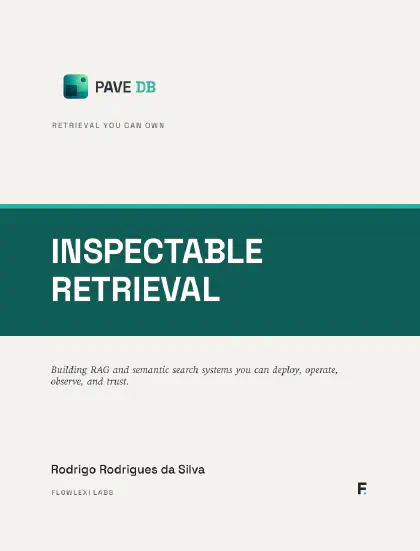 Public draft coming soon
Inspectable Retrieval with PaveDB
Run the same engine embedded or as a service. Learn to inspect
sources, compare query replays and operate your retrieval system.
The full draft will be available by email.
About the book →
Public draft coming soon
Inspectable Retrieval with PaveDB
Run the same engine embedded or as a service. Learn to inspect
sources, compare query replays and operate your retrieval system.
The full draft will be available by email.
About the book →